Research / Boundary-aware reconstruction
Boundary-aware reconstruction
Volumetric particle tracking gives scattered tracks that must be put on a grid before gradients can be computed. When a solid body sits in the measurement volume, standard methods treat everything as fluid and are weakest right next to the body, where it matters most.
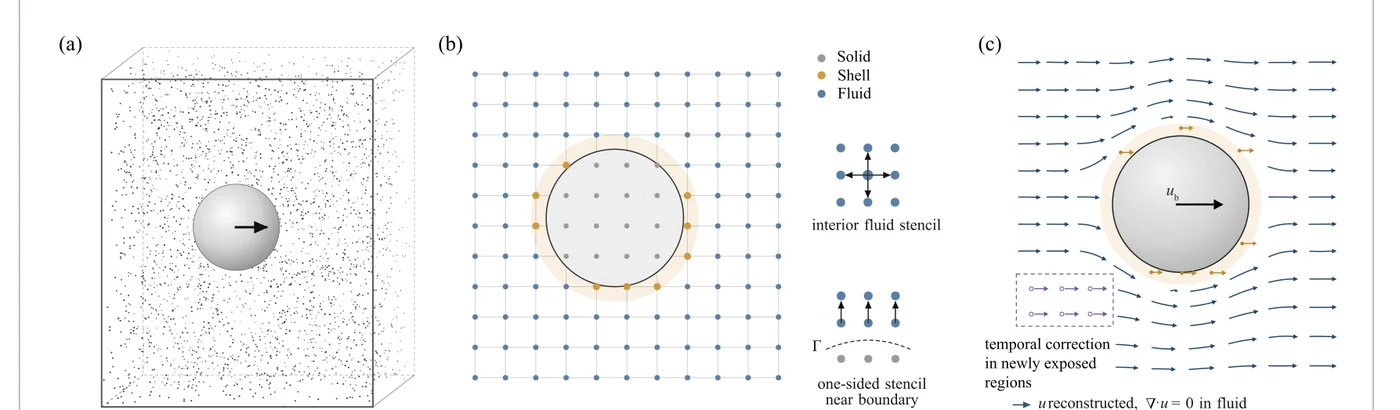
I developed LE-DM (Lagrangian-to-Eulerian reconstruction with Dynamic Masking). At every instant, a time-dependent signed-distance function sorts the grid into open fluid, boundary shell and solid interior. The particle data, incompressibility, the prescribed surface velocity and regularization are then solved together on the masked domain.
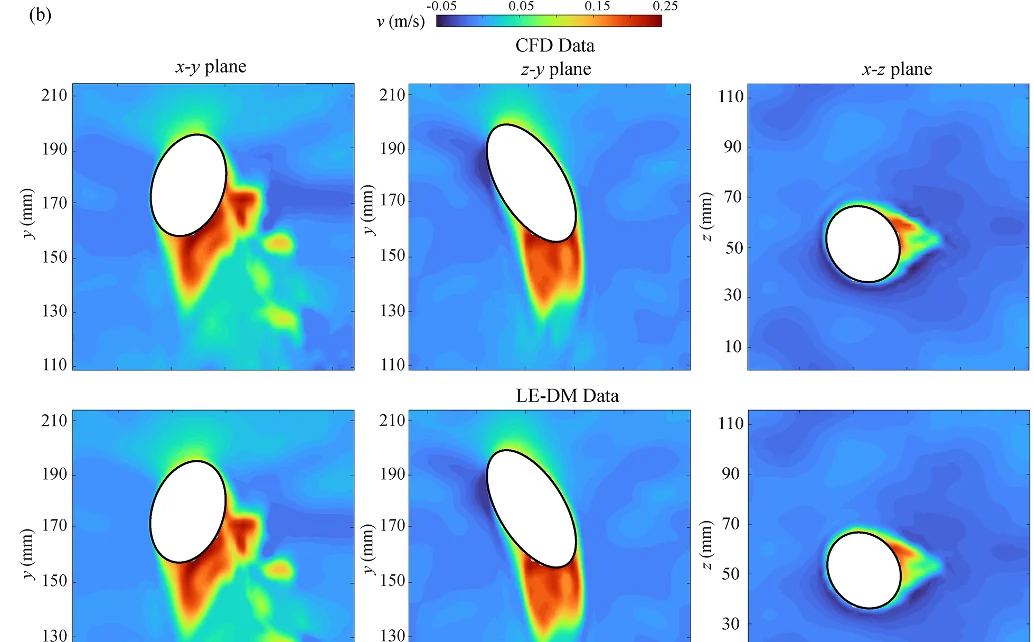
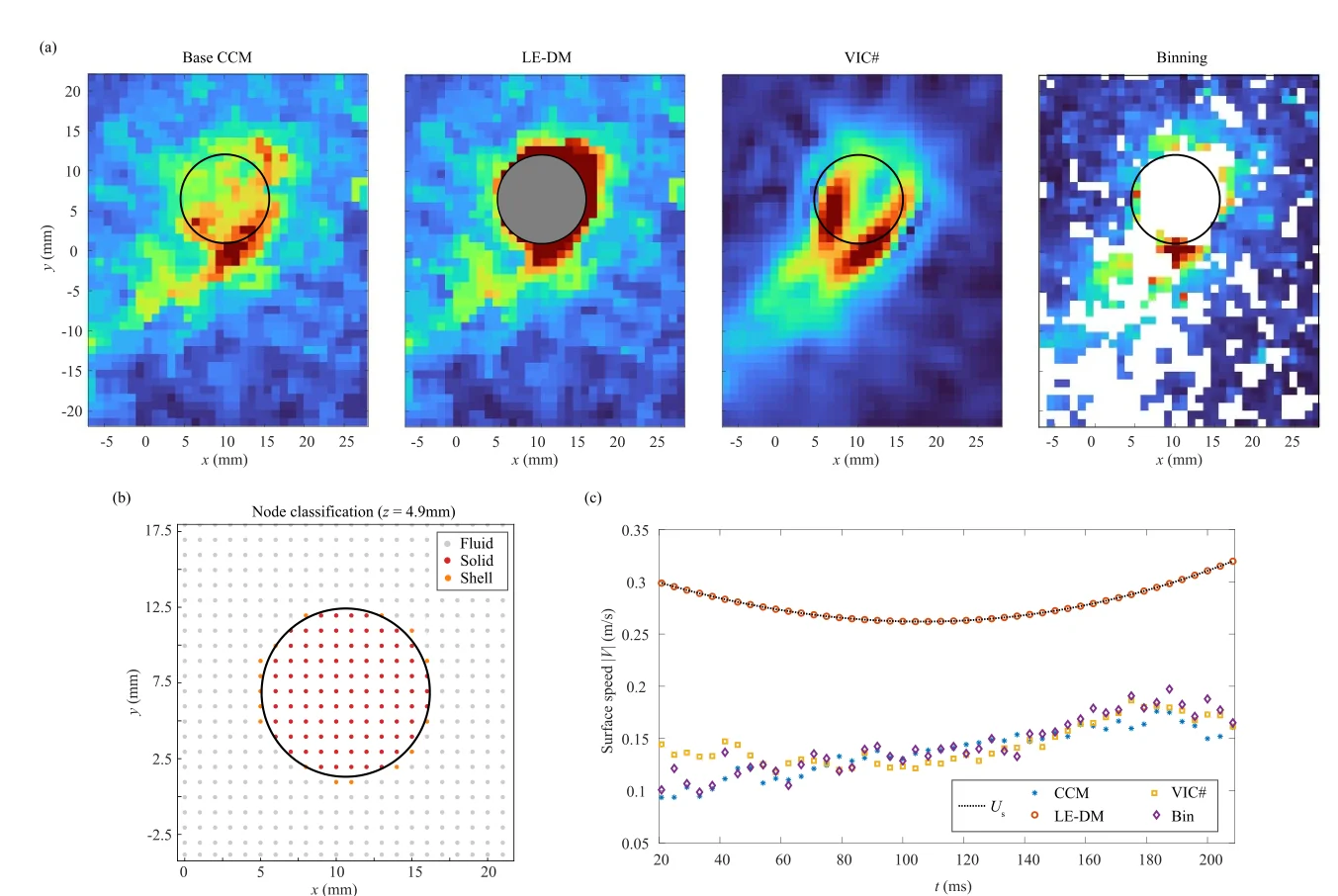
The method needs only the instantaneous surface geometry and velocity, so stationary walls and translating, rotating, multiple or deforming bodies fit the same formulation. It was tested on an analytical oscillating sphere, synthetic tracks from a CFD rising sphere, a freely rising prolate spheroid that tumbles strongly, and a refractive-index-matched tomographic PTV experiment.