Research / Freely moving bodies
Freely moving bodies
How does a body that moves freely under buoyancy interact with its own wake? Refractive-index matching makes transparent solids optically invisible, so the flow right next to the moving body can be measured in three dimensions.
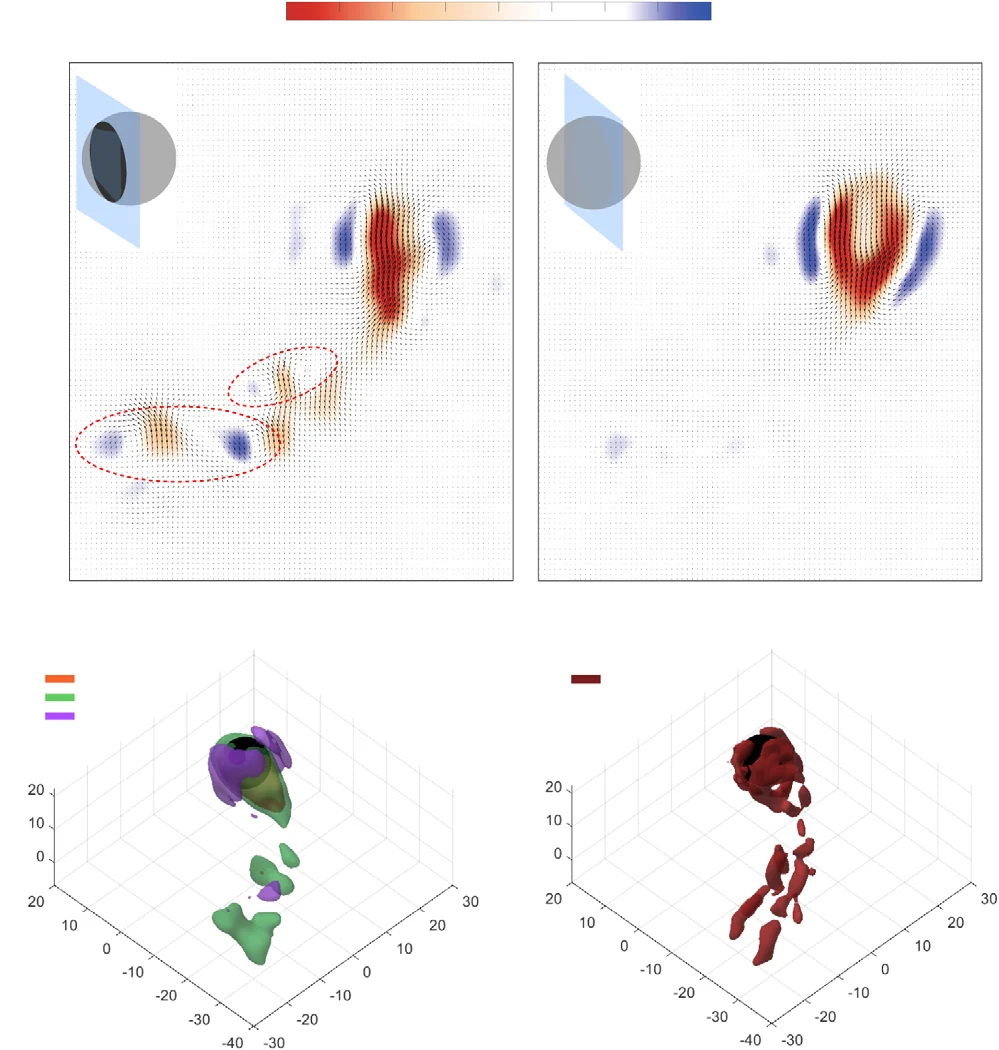
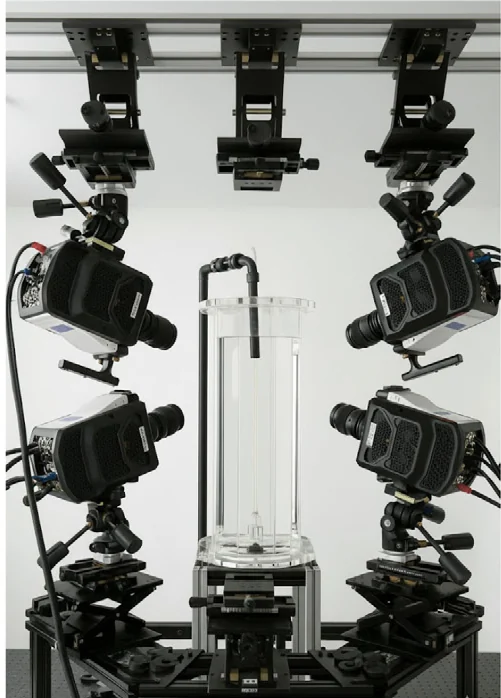
I use time-resolved, four-camera tomographic PTV in a sodium-iodide solution to study acrylic spheres of 7.93, 9.53 and 11.11 mm rising freely. Because the matched spheres cannot be seen directly, a physics-informed detection method locates them by combining the tracer density, the vertical velocity field and the vortex structures in a single optimization.
Together with the volumetric reconstruction, this gives the velocity, pressure and force on the sphere at the same time. The smaller spheres respond mainly to vortex shedding close to the body, while the motion of the larger sphere follows the evolution of coherent vortices in its wake.