Research / Dynamic stall
Dynamic stall
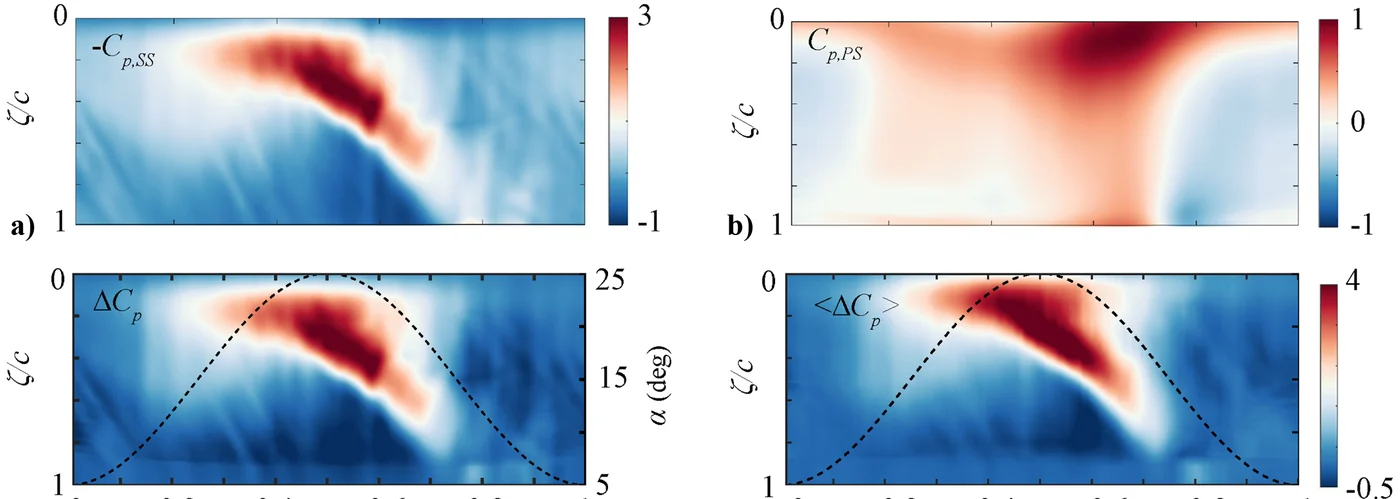
When an airfoil pitches beyond its static stall angle, a large vortex forms on the suction side, briefly boosting lift before it detaches. My Ph.D. at Johns Hopkins connected the flow, the pressure field and the loads during this cycle.
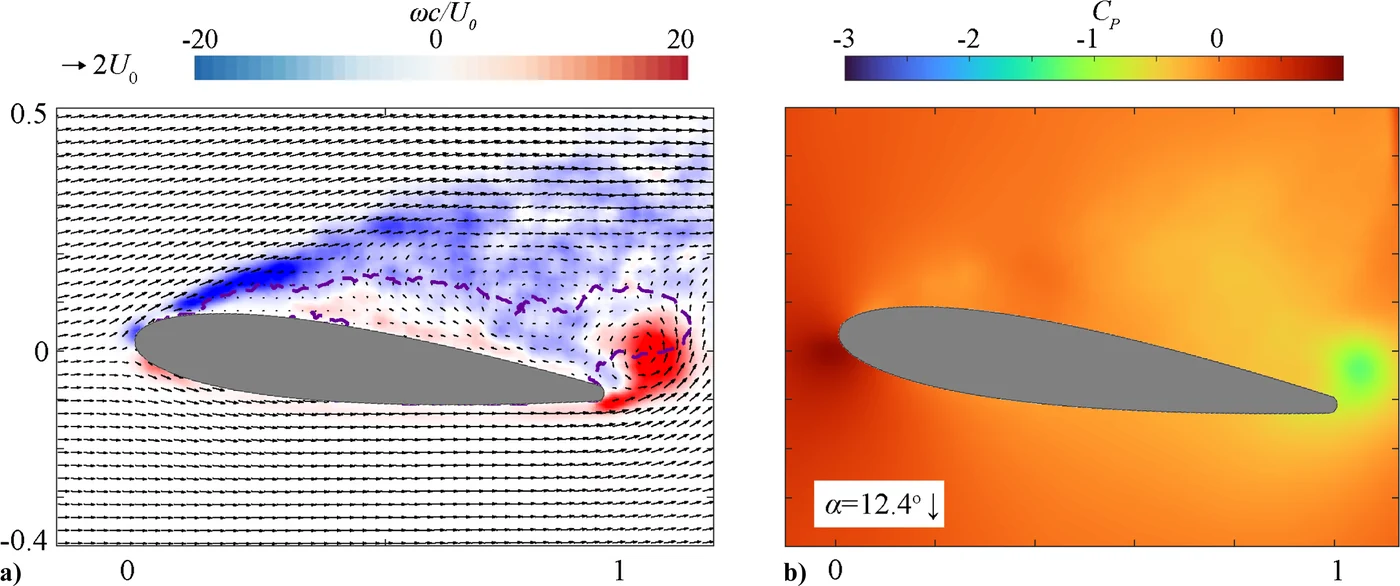
A NACA 0015 airfoil oscillated over reduced frequencies of 0.047 to 1.571 and Reynolds numbers of 13,600 to 136,000. Refractive-index matching allowed stereo PIV on both sides of the transparent airfoil at once, and the pressure field was obtained by integrating the material acceleration. Integrating the surface pressure then gives the lift, pressure drag and moment.
The broad low-pressure region carried by the dynamic-stall vortex delays stall onset and raises the peak lift and drag. The vortex detaches at a fixed fraction (0.3) of the oscillation period and migrates at about 30% of the free-stream speed for all conditions, so once time is shifted by the detachment time, the lift and drag curves collapse.