Research / Turbulent pipe expansions
Turbulent pipe expansions
Separated flows behind steps and expansions set pressure loss, mixing and transport in pipes and ducts. I study how the geometry of an axisymmetric expansion reorganizes the turbulence that follows.
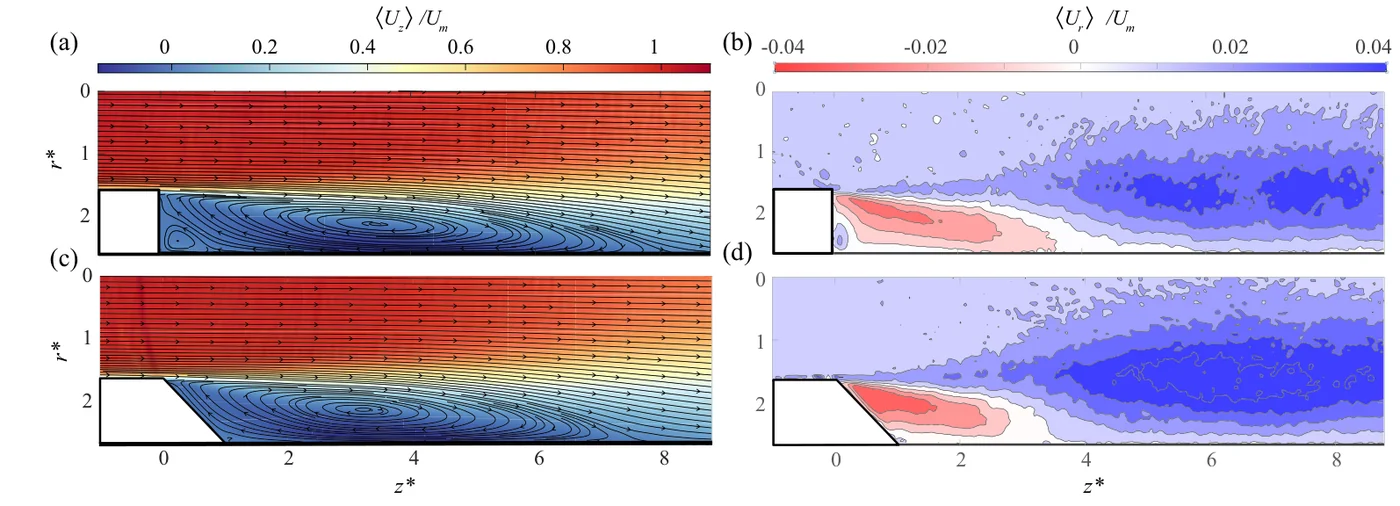
Using refractive-index-matched stereo PIV, I compare abrupt (90°) and gradual (45°) axisymmetric pipe expansions with an area ratio of 2.56 at step-height Reynolds numbers of 25,000 and 35,000. The gradual expansion gives higher turbulence, broader shear layers and stronger anisotropy, because its return flow follows the sloped wall and meets the free stream obliquely. In the abrupt expansion, a secondary vortex disrupts the return flow and reduces turbulence production.
Time-resolved PIV, space–time correlations and Lagrangian coherent structures show that geometry changes how coherent structures are transported near separation, and that these differences fade toward reattachment.