Research / Flow over protrusions
Flow over protrusions
Surface-mounted protrusions trip separation on walls, ducts and vehicles. The flow behind them depends on how the separated flow reaches the trailing edge, and that depends on the protrusion shape.
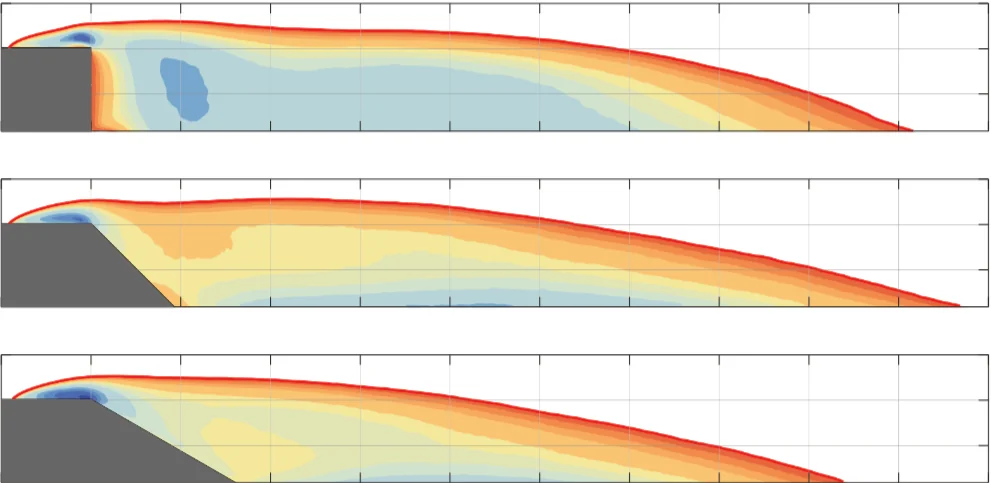
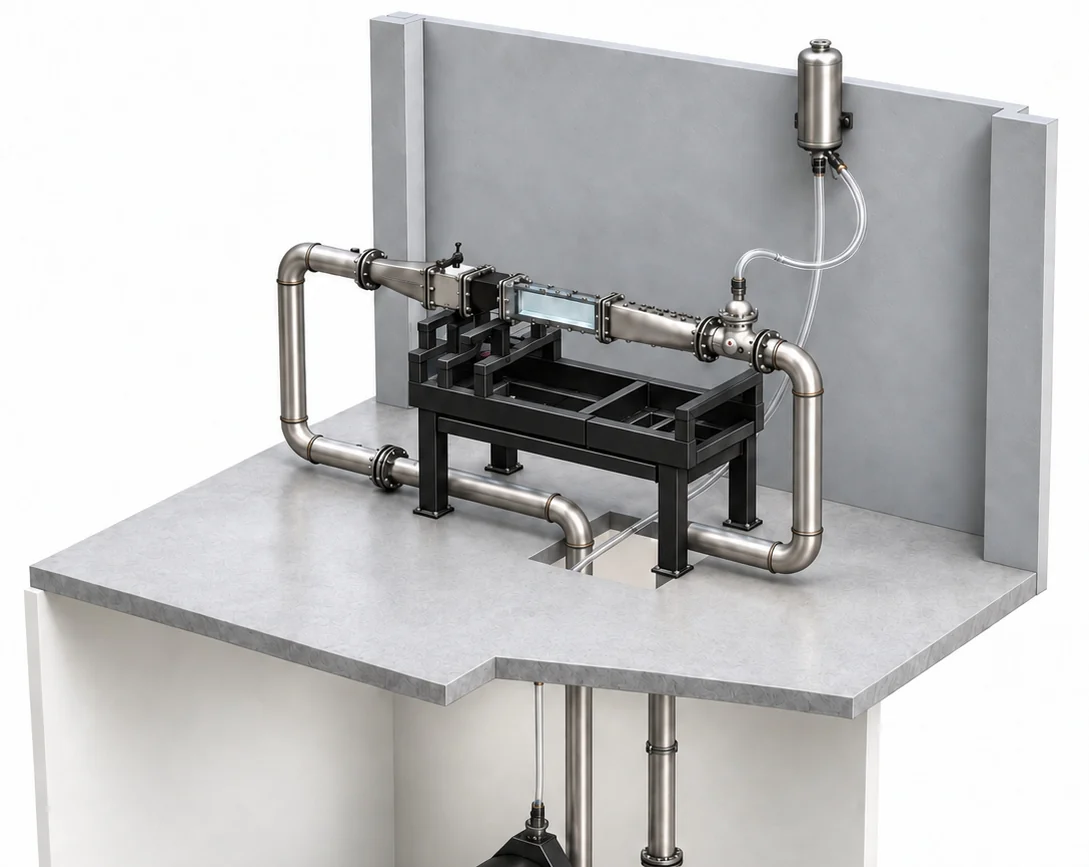
Using stereoscopic PIV in a recirculating water tunnel, we measured the flow over twelve trapezoidal protrusions: upper-surface length-to-height ratios of 1 to 4 and rear-face angles of 30°, 45° and 90°, at a height-based Reynolds number of about 50,000 with an incoming boundary layer comparable in thickness to the protrusion height.
For the two shorter protrusions, one connected reverse-flow region runs over the upper surface into the wake. For the two longer ones, the flow reattaches on the upper surface and the two regions separate. Length sets this topology and the turbulence levels, while the rear-face angle matters most close to the surface: from a length ratio of 2 onward, shallower faces carry more turbulent kinetic energy near the face.